
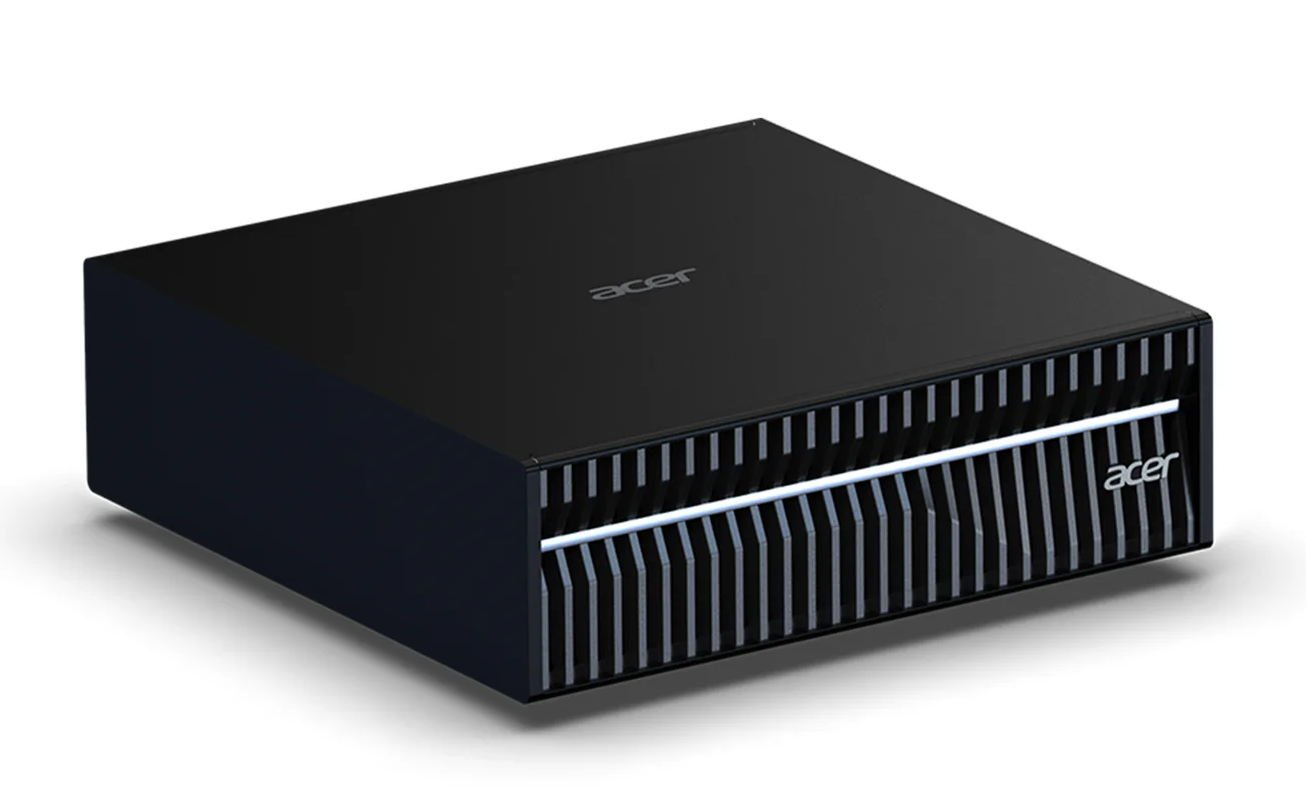
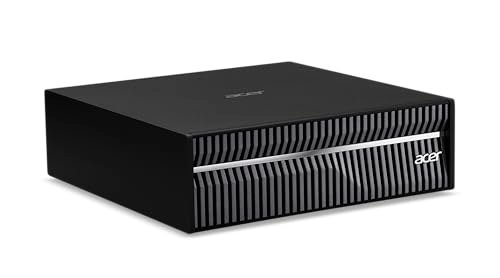
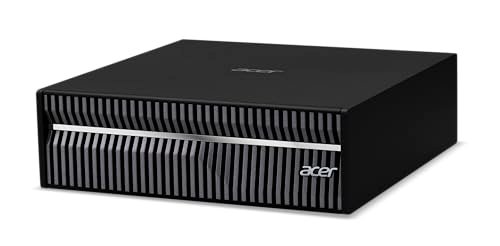


Acer Veriton VGN100-UD11 — DGX Spark AI Workstation (NVIDIA GB10 Grace Blackwell)
$6,499.00
Acer’s AI mini workstation on the NVIDIA GB10 Grace Blackwell platform — 128GB unified memory, 1 petaFLOP FP4.
The Acer Veriton VGN100-UD11 (marketed in North America as the Veriton GN100) is Acer’s entry into the NVIDIA GB10 Grace Blackwell “personal AI supercomputer” category — the same platform underpinning NVIDIA’s own DGX Spark — packaged into a workstation that weighs under three pounds and comes with Acer’s own management software layered on top. For ML engineers and small AI teams who want DGX Spark-class local compute but with Acer’s build quality, monitoring tools, and support channel behind it, this is the alternative worth comparing against the reference design.
Key Features
- NVIDIA GB10 Grace Blackwell Superchip — a 20-core Arm CPU (10x Cortex-X925 performance cores + 10x Cortex-A725 efficiency cores) fused to an integrated Blackwell GB20B GPU with 5th Gen Tensor Cores and 4th Gen RT Cores, rated for up to 1 petaFLOP of FP4 AI performance.
- 128GB Unified LPDDR5x Memory at 273GB/s — coherent memory shared between CPU and GPU (8533MT/s effective), so large models load and run without the VRAM ceiling that limits discrete-GPU workstations.
- Up to 4TB Self-Encrypting NVMe SSD — the top configuration ships with a 4TB Gen5-class NVMe drive; a lower-storage SKU is also available for teams who don’t need the full capacity.
- ConnectX-7 Smart NIC + 10GbE — dual 200Gb/s QSFP ports for clustering multiple units to pool memory for larger models, alongside a dedicated 10 Gigabit Ethernet RJ-45 port for everyday networking.
- Acer Sense Pro Management Software — Acer’s own dashboard layered on top of NVIDIA DGX OS, giving real-time CPU/GPU/memory/thermal monitoring, hardware tuning, inference benchmarking (tokens-per-second and time-to-first-token charts), and self-diagnostics — visibility a bare reference-design unit doesn’t offer out of the box.
- Full NVIDIA DGX OS + AI Stack — ships on Ubuntu 24.04 LTS for Arm with NVIDIA DGX OS, PyTorch, Jupyter, and Ollama pre-installed, plus NVIDIA Sync support for remote management over the network.
- Genuinely Portable Footprint — 5.9 x 5.9 x 2 inches and roughly 1.2kg (2.65 lbs), powered from a 240W external adapter, with 4x USB-C ports (3x USB-C 3.2 Gen2x2 at 20Gbps carrying DisplayPort 2.1, plus 1x USB-C PD-in) and HDMI 2.1 for multi-monitor visualisation.
- Wireless & Physical Security — Wi-Fi 7, Bluetooth 5.4, and a Kensington lock slot for organisations deploying units outside a locked server room.
DGX Spark Compute, Acer’s Software Layer on Top
Every GB10-based system shares the same core advantage: a coherent 128GB memory pool addressable by both CPU and GPU at 273GB/s, which is what lets a machine this size hold and run models in the 70B–200B parameter class that would immediately exceed the VRAM of most workstation GPUs. What Acer adds on top of that shared foundation is Acer Sense Pro — a genuinely useful layer for anyone who wants to see GPU temperature, memory pressure, and live inference throughput without dropping to a terminal every time, plus a built-in benchmarking view that reports tokens-per-second and time-to-first-token directly, which is exactly the metric ML engineers actually care about day to day.
Because it runs the identical NVIDIA DGX OS and CUDA stack as every other GB10-class device, workloads developed here move to a DGX Spark, a DGX cluster, or DGX Cloud without modification — Acer’s software adds visibility and management, it doesn’t fork the underlying platform. That’s an important distinction for this audience: you’re not locked into a proprietary toolchain, you’re getting the standard NVIDIA AI stack with a better dashboard.
Being direct about honest limits: the 1 petaFLOP figure is a peak FP4-with-sparsity number, and real dense-precision throughput on a given model will be lower. This is a fine-tuning, quantization, and inference machine, not a from-scratch foundation-model trainer — that workload still belongs on a cluster. Multiple GN100/VGN100 units can be networked over ConnectX-7 to pool memory for larger models; Acer’s original launch materials cited two units linked for models up to roughly 405B parameters, with later materials referencing larger multi-unit clusters for even bigger model classes as the ecosystem around GB10 clustering has matured.
For a research group or AI studio evaluating GB10-platform hardware, the practical decision usually comes down to software polish and support channel rather than raw silicon — since the underlying GB10 Superchip, memory architecture, and DGX OS stack are the same across every implementation. Acer’s pitch is the management tooling and a workstation brand with an established enterprise support and warranty structure behind it.
Specifications
- Model: Veriton VGN100-UD11 (Veriton GN100 AI Mini Workstation)
- Superchip: NVIDIA GB10 Grace Blackwell
- CPU: 20-core Arm (10x Cortex-X925 + 10x Cortex-A725)
- GPU: NVIDIA Blackwell GB20B, 5th Gen Tensor Cores, 4th Gen RT Cores
- AI Performance: Up to 1 petaFLOP (FP4, with sparsity)
- Memory: 128GB LPDDR5x unified memory, 8533MT/s, 273GB/s bandwidth
- Storage: Up to 4TB self-encrypting NVMe SSD (lower-capacity SKUs available)
- Networking: NVIDIA ConnectX-7 Smart NIC (dual 200Gb/s QSFP), 10 Gigabit Ethernet (RJ-45)
- Wireless: Wi-Fi 7, Bluetooth 5.4
- Ports: 3x USB-C 3.2 Gen2x2 (20Gbps) with DisplayPort 2.1, 1x USB-C PD-in, HDMI 2.1
- Security: Self-encrypting SSD, Kensington lock slot
- Software: NVIDIA DGX OS (Ubuntu 24.04 LTS Arm), Acer Sense Pro dashboard, NVIDIA Sync, PyTorch, Jupyter, Ollama pre-installed
- Power Supply: 240W external adapter
- Dimensions: 5.9 x 5.9 x 2 inches (150 x 150 x 50.5mm)
- Weight: Approx. 1.2kg (2.65 lbs)
- Clustering: Multi-unit clustering via ConnectX-7 for pooled memory on larger model classes



Greta W. –
One quirk worth mentioning: driving more than one external display beyond the USB-C outputs got finicky with our docking station until a firmware update a few weeks after purchase fixed it. HDMI 2.1 output itself has been reliable throughout. Everything else about the machine has been excellent.
Omar K. –
Under three pounds and I’ve taken this to two conferences now for live model demos instead of relying on a laptop with an eGPU rig. Full DGX OS and AI stack in something this portable still feels a little unreal.
Camille D. –
WiFi 7 was intermittent for the first couple of weeks until an Acer firmware update resolved it — mildly annoying during setup but support was responsive and it’s been completely stable since. Compact chassis and quiet operation make it an easy fit for a shared lab desk.
Bianca F. –
Same GB10 Grace Blackwell platform as the reference DGX Spark, so performance expectations should be the same: strong prefill, bandwidth-bound decode on dense models, excellent for fine-tuning and 200B-class inference. Acer’s port selection stands out though — three USB-C 3.2 Gen2x2 with DisplayPort 2.1 gave me more flexible monitor options than most competing boxes in this category.
Nikhil R. –
Tracked our cloud GPU spend for three months before switching most of our fine-tuning and inference experimentation to this box — we’re saving meaningfully every month now that experimentation happens locally instead of on rented A100 instances, and the identical NVIDIA stack meant zero workflow changes.