
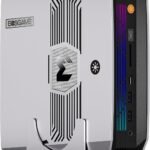
MINISFORUM MS-S1 Max Mini Workstation (Ryzen AI Max+ 395)
Price range: $2,469.00 through $3,199.00
AMD Ryzen AI Max+ 395, up to 128GB LPDDR5x, dual 10GbE, USB4 V2 — compact AI workstation.
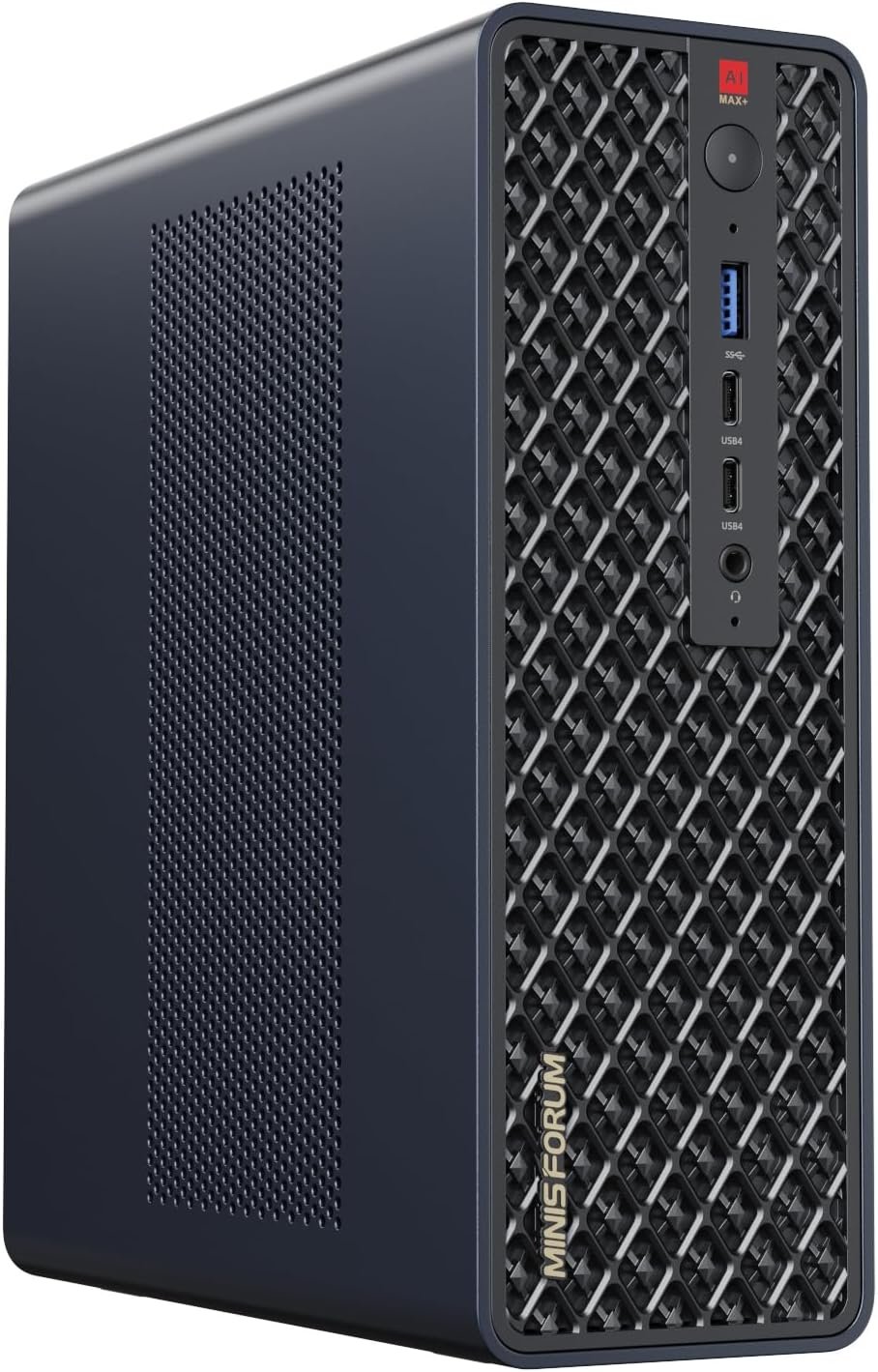
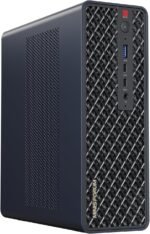
The MINISFORUM MS-S1 Max is a mini AI workstation built around AMD’s flagship Ryzen AI Max+ 395 processor, engineered for developers and small studios who need serious local LLM inference performance plus something none of its Strix Halo competitors offer: a full-length PCIe x16 slot for a discrete GPU. It’s the rare mini PC that can scale from integrated-graphics AI inference to a genuine discrete-GPU workstation without changing chassis.
Key Features
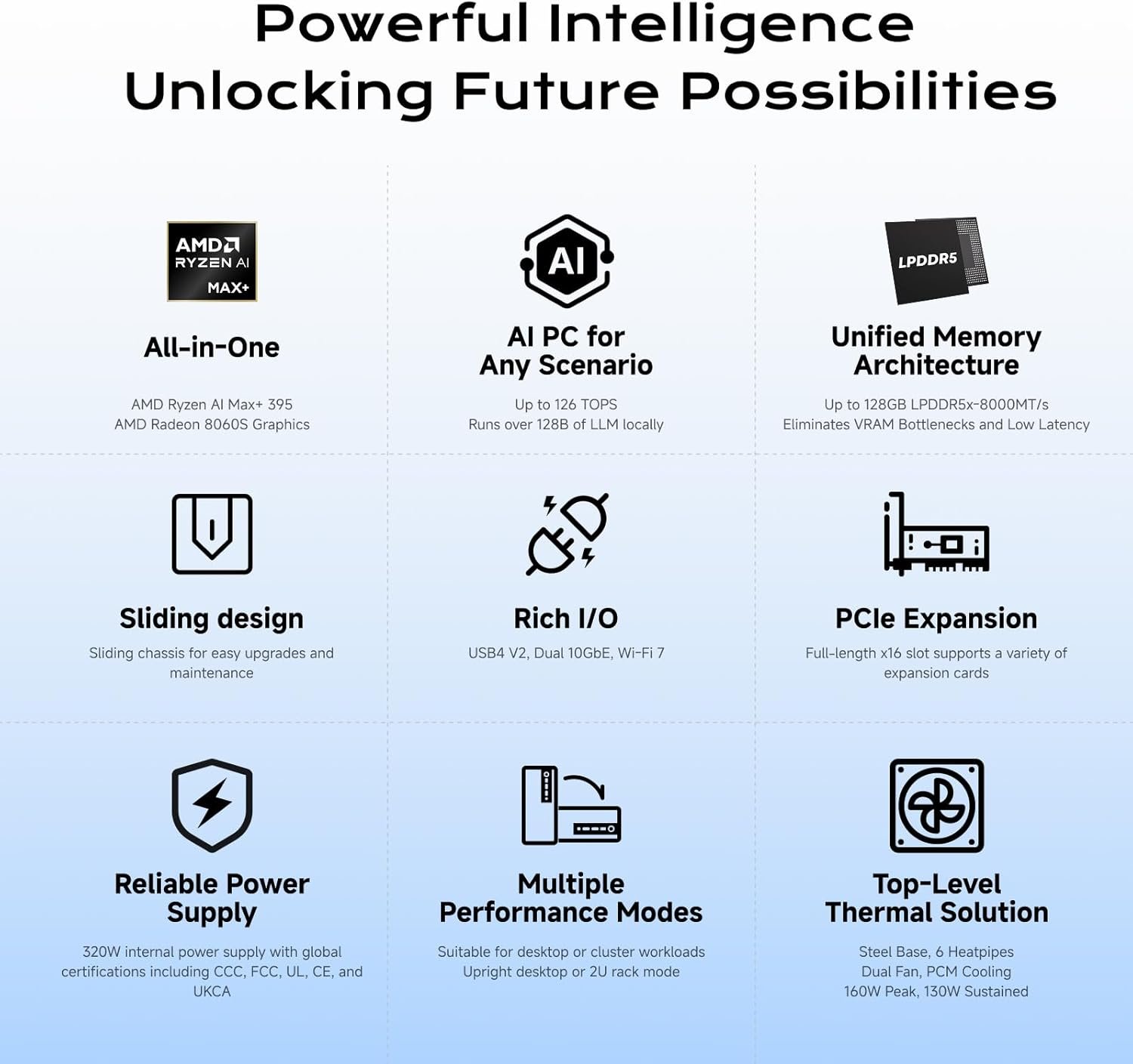
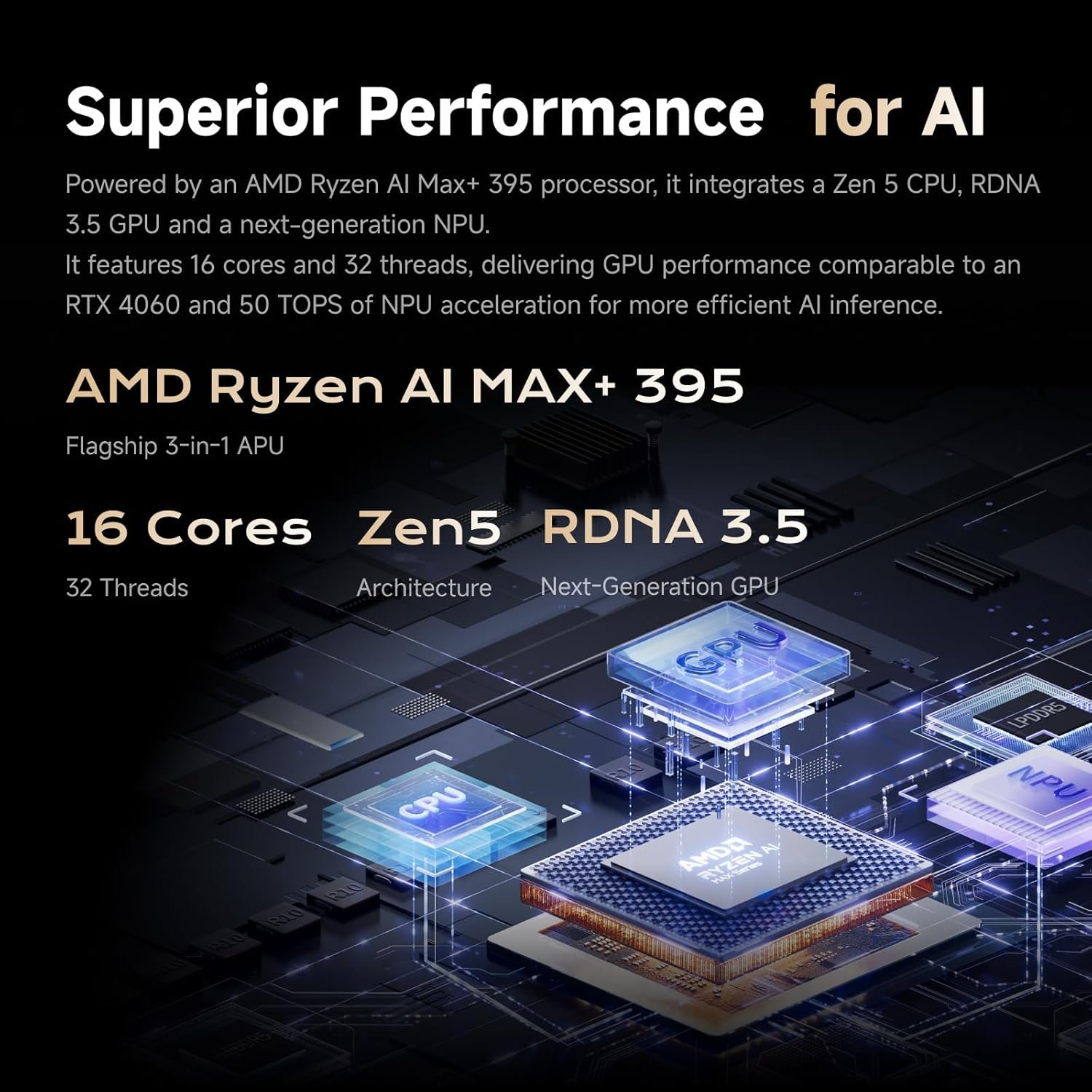
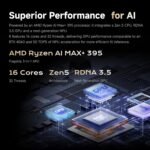
- AMD Ryzen AI Max+ 395 Processor — 16 Zen 5 cores / 32 threads at 3.0–5.1GHz, paired with integrated Radeon 8060S graphics (40 RDNA 3.5 compute units up to 2.9GHz) for real desktop-class compute, not just AI acceleration.
- Up to 126 TOPS Combined AI Performance — the XDNA 2 NPU alone delivers 50 TOPS, with the platform-wide 126 TOPS figure reflecting combined CPU, GPU, and NPU throughput on real AI workloads.
- Up to 128GB LPDDR5x Unified Memory at 8000MT/s — a 256-bit memory bus shared across CPU, GPU, and NPU, giving local LLM inference genuine headroom for large open-weight models.
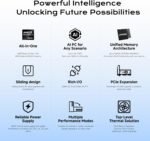
- Full-Length PCIe 4.0 x16 Expansion Slot — the standout feature in this category: add a discrete GPU for CUDA-specific workloads, additional VRAM, or gaming, something no other Strix Halo mini PC in this class offers.
- Dual USB4 V2 Ports at 80Gbps — the rear pair runs the newer USB4 V2 standard at double the bandwidth of standard USB4, alongside two additional 40Gbps USB4 ports up front, for high-speed external storage arrays or displays.
- Dual 10 Gigabit Ethernet — genuine 10GbE networking on both ports, not the 2.5GbE compromise common on competing mini PCs, for teams moving large datasets or checkpoints across a local network regularly.
- Asymmetric Dual M.2 Storage, Up to 16TB — one PCIe 4.0 x4 slot at full speed plus a second capped at roughly 2GB/s, both supporting up to 8TB drives with RAID 0/1 support — worth knowing which slot to put your primary boot/model drive in.
- Copper-Substrate Cooling with Dual Centrifugal Turbine Fans — six heat pipes and phase-change thermal material spinning fans up to 3,600RPM, engineered to sustain the platform’s 320W built-in power supply under continuous AI workloads.
The Strix Halo Mini PC That Doesn’t Box You In
Every Ryzen AI Max+ 395 mini PC offers roughly the same CPU, NPU, and integrated GPU numbers — what separates the MS-S1 Max is the PCIe x16 expansion slot. That single decision changes what this machine can become: start with the integrated Radeon 8060S and 128GB of unified memory for CPU/NPU-driven local inference, and if a project later needs CUDA-specific tooling, more VRAM than an APU can offer, or raw discrete-GPU throughput, you can add a graphics card without buying an entirely new machine. For a small AI studio or robotics team whose hardware needs evolve project to project, that flexibility is worth more than a marginally smaller footprint.
The storage and networking configuration reflects real workstation thinking rather than consumer mini-PC defaults: dual 10GbE ports for teams that actually saturate gigabit networking moving model checkpoints and datasets, and 80Gbps USB4 V2 on the rear ports for external NVMe enclosures or high-refresh displays. The asymmetric dual-M.2 design is worth planning around — put your OS and active model files on the full-speed PCIe 4.0 x4 slot, and treat the second, single-lane slot as archival storage for less latency-sensitive data.
Being straightforward about trade-offs: 320W of built-in power supply and a 130W CPU-package performance mode mean this is a genuinely power-hungry machine by mini-PC standards, and the copper-and-turbine cooling system exists specifically to manage that heat load, which some users may find audibly present under sustained Extreme-mode workloads. As with every Strix Halo platform, ROCm software support has matured significantly but still lags CUDA’s ecosystem depth for the newest inference frameworks — a real consideration if your workflow is CUDA-first, though it’s precisely the gap the PCIe expansion slot lets you close by adding an NVIDIA card later. For local LLM inference in the 30B–70B parameter range, agentic pipeline development, and workloads that benefit from future GPU expansion without a full hardware refresh, the MS-S1 Max is the most flexible Strix Halo platform currently available.
Specifications
- Processor: AMD Ryzen AI Max+ 395, 16 cores / 32 threads (Zen 5), 3.0–5.1GHz
- GPU: AMD Radeon 8060S, 40 RDNA 3.5 compute units, up to 2.9GHz
- NPU: AMD XDNA 2, up to 50 TOPS (up to 126 TOPS combined platform AI performance)
- Memory: Up to 128GB LPDDR5x, 256-bit bus, 8000MT/s
- Expansion: Full-length PCIe 4.0 x16 slot for discrete GPU
- Storage: Dual M.2 2280 NVMe — Slot 1: PCIe 4.0 x4 (full speed, up to 8TB); Slot 2: single-lane (~2GB/s, up to 8TB); RAID 0/1 supported, up to 16TB total
- Networking: Dual 10 Gigabit Ethernet (RJ-45), Wi-Fi 7, Bluetooth 5.4
- USB: 2x USB4 V2 (80Gbps, rear), 2x USB4 (40Gbps, front, DP Alt 2.0), 1x USB-A 10Gbps (front), 2x USB-A 3.2 Gen2 (rear), 2x USB 2.0 (rear)
- Display: 1x HDMI 2.1 FRL (8K@60Hz / 4K@120Hz), DisplayPort Alt Mode via USB4
- Cooling: Copper-substrate design, 6 heat pipes, phase-change thermal material, dual centrifugal turbine fans (up to 3,600RPM)
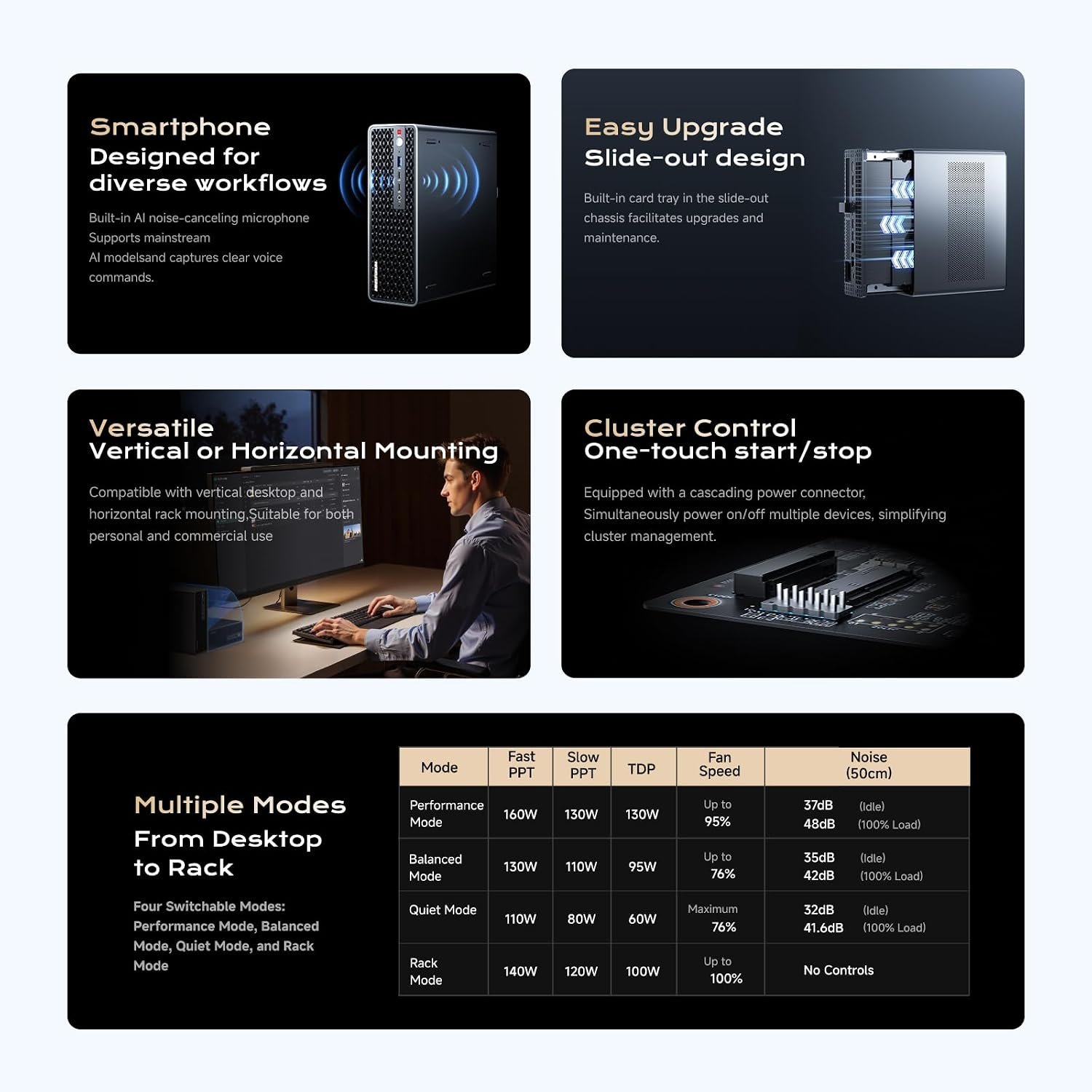
- Power: Built-in 320W PSU; TDP profiles — Performance 130W, Balanced 95W, Quiet 60W
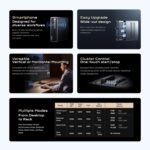
- Chassis: Slide-out, tool-less internal access; VESA mount compatible; Kensington lock slot
- Other Features: Dual directional microphones with AI noise cancellation; four selectable operation modes
- Dimensions: 222.1 x 206.3 x 77.1mm
- Weight: 2.8kg
- Configurations Available: 64GB RAM / 2TB SSD; 128GB RAM / 2TB SSD
| Configuration | 64GB RAM / 2TB SSD, 128GB RAM / 2TB SSD |
|---|
5 reviews for MINISFORUM MS-S1 Max Mini Workstation (Ryzen AI Max+ 395)
Related products


ASUS Ascent GX10 AI Supercomputer (NVIDIA GB10 Superchip)
Price range: $5,899.00 through $7,899.00


Dell Pro Micro AI Business Mini Desktop (AMD Ryzen 5 8500GE)
Price range: $2,539.99 through $3,389.99

Dell Pro Micro QCM1250 AI Business Mini Desktop (Intel Ultra 5-235T)
Price range: $2,362.49 through $3,449.99

HP ProDesk 4 Mini G1i AI Business Mini Desktop (Intel Ultra 5-235T)
Price range: $2,249.99 through $2,699.99

HP Z2 Mini G1a Workstation (AMD Ryzen AI MAX PRO)
Price range: $3,523.99 through $4,406.83

Beelink GTi14 Ultra AI PC Intel® Core™ UItra 9 185H (OpenClaw Pre-Installed)
Price range: $1,099.00 through $1,399.00

Wei C. –
The copper-substrate cooling with dual turbine fans genuinely earns its keep — ran a 320W sustained load for hours during a big fine-tuning job and never saw thermal throttling kick in, which is more than I can say for some competing Strix Halo boxes.
Lucas P. –
Tried an eGPU over the USB4 V2 (80Gbps) port for extra throughput and it does work, but the ROCm-plus-eGPU combination is clearly still early days — took some trial and error to get stable. On its own, without the eGPU, the box performs great.
Mei H. –
Consolidated three older machines in my home AI lab into this single unit. Getting respectable tokens/sec on 30B-class models and the dual-fan cooling keeps it quiet even under load, which matters since it sits a few feet from my desk.
Aisha N. –
Dual 10GbE ports meant I could hook this straight into our NAS for large dataset access without a bottleneck, which for anyone doing serious local training work is a bigger deal than it sounds — most mini PCs in this category ship with a single 1GbE port.
Julian K. –
Same standard caveat as other Strix Halo machines: ROCm support for this chip is still preview-grade, and I had to manually set the HSA override environment variable to get everything recognized properly. Once past that ten-minute setup step it’s been a genuinely solid value box for local LLM work.