



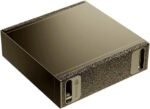
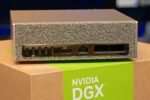
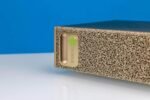
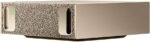
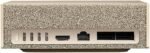
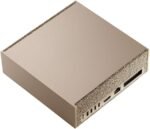
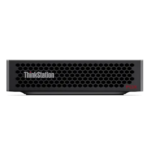

NVIDIA DGX Spark™ – Personal AI Desktop Supercomputer – Desktop GB10 Grace Blackwell Chip
Price range: $4,699.00 through $9,617.99
Supercomputer performance directly to your desk in a compact, energy-efficient design, enabling enterprise-scale AI and high-performance computing right where you need it. The power of Grace Blackwell architecture, delivering up to 1 petaFLOP of AI performance for local model fine-tuning, inference, and analytics, acce
The NVIDIA DGX Spark puts data-centre-class AI compute inside a chassis the size of a hardback book, built for machine learning engineers, researchers, and small AI teams who need to prototype, fine-tune, and run large models locally instead of queuing for cluster time or metering every experiment against a cloud GPU bill. If your current workflow means spinning up an A100 or H100 instance every time you want to test a fine-tune, DGX Spark turns that iteration loop into hardware that sits permanently on your desk — no idle-GPU billing, no dataset leaving the building, and no waiting behind other researchers on shared infrastructure.
Key Features
- NVIDIA GB10 Grace Blackwell Superchip — a 20-core Arm CPU (10x Cortex-X925 performance cores + 10x Cortex-A725 efficiency cores) fused to a Blackwell-architecture GPU with 5th-generation Tensor Cores and 4th-generation RT Cores over NVLink-C2C, rated for up to 1 petaFLOP of FP4 AI compute with sparsity. This is the same silicon family NVIDIA ships in its DGX data-centre systems, scaled into a desktop form factor.
- 128GB Unified LPDDR5x Memory at 273GB/s — CPU and GPU share one coherent 128GB pool over a 256-bit memory interface, so there’s no PCIe round-trip copying data between system RAM and VRAM. This is the single biggest reason DGX Spark can hold models that would immediately run out of memory on a 24GB or even 48GB discrete workstation GPU.
- Run and Fine-Tune Models Up to ~200B Parameters — at FP4 precision, a single unit comfortably hosts models in the 70B–200B class for local inference, LoRA/QLoRA fine-tuning, and RAG pipeline development, fully offline and air-gapped if required.
- 4TB Self-Encrypting NVMe SSD — enough local headroom for multiple model checkpoints, quantized variants, container images, and full training datasets without constant shuffling to external storage.
- ConnectX-7 Smart NIC (200Gbps) — the same networking class NVIDIA deploys in its data-centre systems. Pair two DGX Spark units with a certified QSFP112 interconnect cable and pool 256GB of unified memory to run inference on models up to roughly 405B parameters.
- Full NVIDIA DGX OS + AI Stack, Pre-Installed — CUDA, cuDNN, NCCL, PyTorch and TensorFlow containers, NVIDIA AI Workbench, and accelerated frameworks such as Isaac, Metropolis, and Holoscan ship ready to use out of the box. Workloads developed here are container-portable to any other Blackwell system or DGX Cloud instance without code changes.
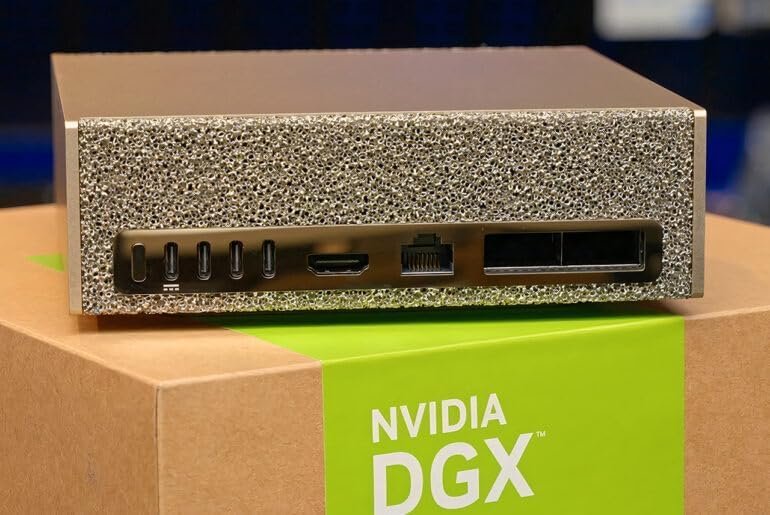
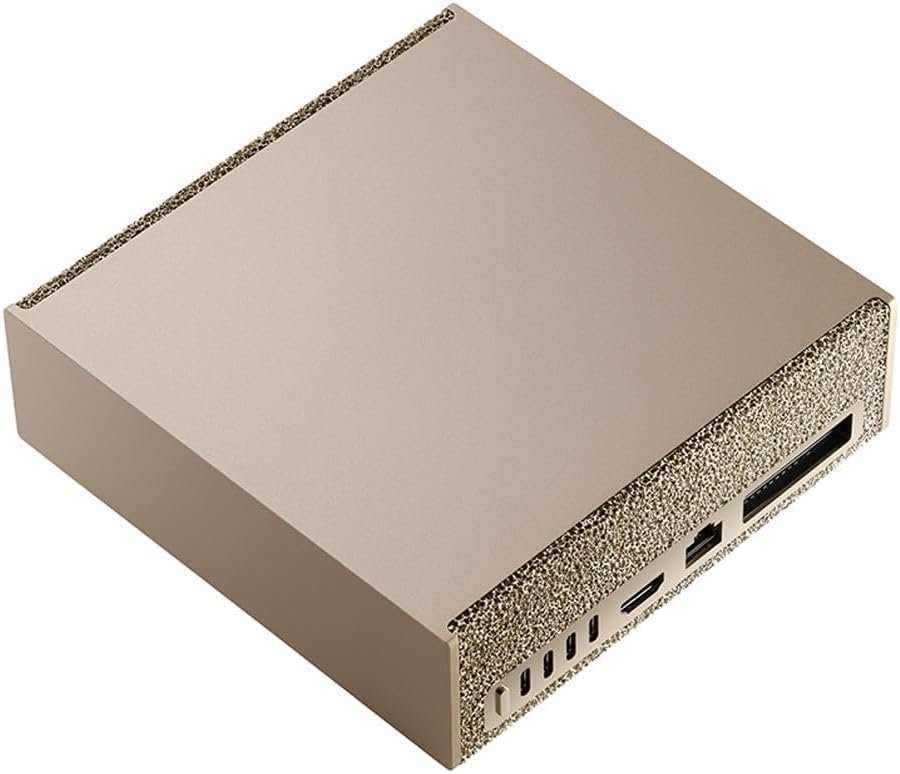
- Desktop Footprint, Data-Centre Silicon — 150 x 150 x 50.5mm and 1.2kg, powered from a single 240W supply, with 1x HDMI 2.1a and up to 3x DisplayPort 2.1 over USB-C for a full multi-monitor visualisation setup alongside training runs.
- Enterprise-Grade I/O — 4x USB Type-C, 10 Gigabit Ethernet (RJ-45), Wi-Fi 7, and Bluetooth 5.4 round out a connectivity list built for a professional desk, not a hobbyist board.
Built for Local AI Development, Not Cloud-Dependent Demos
DGX Spark exists to solve a specific, expensive problem: the gap between a laptop that can’t run a serious model and a cloud GPU bill that punishes exploratory work. Fine-tuning an open-weight 70B model, iterating on a RAG pipeline against a private document set, or benchmarking quantization strategies are all workflows that involve dozens of short, iterative runs — exactly the pattern that turns hourly cloud billing into an unpredictable monthly invoice. With 128GB of unified memory addressable by both the CPU and GPU, DGX Spark can load models that simply do not fit in the VRAM of most workstation and even many data-centre GPUs, without the complexity of tensor-parallel sharding across multiple cards.
The unified memory architecture is the differentiator worth understanding before you buy. On a discrete-GPU workstation, model weights, KV cache, and activations all have to fit inside the GPU’s own VRAM pool, and anything that doesn’t fit either gets offloaded to system RAM (with a severe throughput penalty) or simply fails to load. On DGX Spark, the GPU addresses the same 128GB LPDDR5x pool the CPU uses, at 273GB/s — so a 70B-parameter model in FP4/INT4 quantization, or a 30B model at higher precision with generous context length, loads and runs without the memory-management gymnastics that plague consumer GPU setups.
Honesty matters to this audience, so it’s worth being direct about where DGX Spark fits and where it doesn’t. The 1 petaFLOP figure is a peak FP4-with-sparsity number, and real-world dense-precision throughput on a given model will be meaningfully lower — treat it as a ceiling, not an expectation for every workload. DGX Spark is also not a from-scratch foundation-model training rig; its 273GB/s memory bandwidth and single-GPU-equivalent compute budget mean pre-training multi-billion-parameter models from random initialization is still cluster or cloud territory. Where it earns its keep is fine-tuning, quantization work, inference serving, agentic pipeline development, and computer-vision or multimodal prototyping — the day-to-day iteration loop that consumes the majority of most ML engineers’ working hours, now running entirely on hardware you own.
Because it ships on NVIDIA DGX OS — an Ubuntu Linux Pro-based distribution with the full CUDA and container stack preinstalled — the software experience is close to what you’d get on a DGX cluster or DGX Cloud instance, not a stripped-down ARM Linux port. That matters for anyone who has tried to get an unsupported ML framework working on ARM hardware before: the ecosystem here is the one NVIDIA itself maintains and ships to enterprise customers, which meaningfully de-risks the “will my stack even work” question that comes with any Arm-based workstation.
Two configurations are available: a Single Unit for teams whose model sizes fit within 128GB, and a Dual Unit + Interconnect Cable bundle — two DGX Spark units plus an NVIDIA-certified ConnectX-7 QSFP112 cable, pre-matched for clustering — for teams who want to pool 256GB of unified memory and run inference on models up to roughly 405B parameters. Choose the configuration that matches the largest model class you expect to work with over the machine’s lifetime.
Specifications
- Superchip: NVIDIA GB10 Grace Blackwell
- CPU: 20-core Arm (10x Cortex-X925 + 10x Cortex-A725)
- GPU: NVIDIA Blackwell architecture, 5th Gen Tensor Cores, 4th Gen RT Cores
- CPU-GPU Interconnect: NVLink-C2C
- AI Performance: Up to 1 petaFLOP (FP4, with sparsity)
- System Memory: 128GB LPDDR5x, coherent unified memory
- Memory Interface / Bandwidth: 256-bit / up to 273GB/s
- Storage: 4TB NVMe M.2, self-encrypting
- Networking: NVIDIA ConnectX-7 Smart NIC (200Gbps), 10 Gigabit Ethernet (RJ-45), Wi-Fi 7, Bluetooth 5.4
- USB: 4x USB Type-C
- Display Outputs: 1x HDMI 2.1a, up to 3x DisplayPort 2.1 (USB-C DP Alt Mode)
- Video Encode/Decode: 1x NVENC / 1x NVDEC
- Operating System: NVIDIA DGX OS with full NVIDIA AI software stack (CUDA, cuDNN, NCCL, container runtime)
- Max Model Size: ~200B parameters (single unit); ~405B parameters (dual-unit clustered, 256GB pooled memory)
- Power Supply: 240W (GB10 TDP 140W)
- Dimensions: 150 x 150 x 50.5mm
- Weight: 1.2kg
- Configurations: Single Unit; Dual Unit + Interconnect Cable (NVIDIA-certified ConnectX-7 QSFP112)
| Configuration | Single Unit, Dual Unit + Interconnect Cable |
|---|
16 reviews for NVIDIA DGX Spark™ – Personal AI Desktop Supercomputer – Desktop GB10 Grace Blackwell Chip
Related products


Dell Pro Micro AI Business Mini Desktop (AMD Ryzen 5 8500GE)
Price range: $2,539.99 through $3,389.99


Tomás G. –
Worth being upfront: dense 32B+ models decode slower than the marketing suggests because you’re bound by the 273GB/s memory bandwidth, not the petaflop number. MoE models like gpt-oss fly though — I’m seeing well over 30 tok/s there. Once I understood which model architectures actually suit this hardware it became one of the most useful machines in our small lab. Four stars only because the FP4 headline number oversells dense-model performance a bit.
Oskar D. –
The hardware itself is impressive but I want to be honest about the rough edges: DGX OS is an Arm-based Ubuntu variant, and a handful of Python packages I use daily didn’t have Arm wheels yet, so I lost an afternoon building from source. Docker images built for x86 obviously won’t run either. None of this is unexpected given how new Arm-based AI desktops are, but at this price point I expected a smoother first week. Still keeping it — just don’t buy this as your only machine if your stack isn’t CUDA-native already.
Daniel K. –
Been running Llama 3.1 70B and Mistral Large quantized on this for about six weeks now. Prefill/prompt processing is genuinely fast thanks to the Blackwell tensor cores, and since it’s native CUDA everything just installs — vLLM, llama.cpp, Ollama, no fighting with translation layers like on other unified-memory boxes. Decode throughput on dense 70B is bandwidth-limited as expected (~10-13 tok/s), but for prototyping and fine-tuning work that never leaves my desk it’s completely worth it. Quiet enough to sit next to my monitor all day.
Elena V. –
Running local diffusion model fine-tunes and the 128GB unified pool means I can use much larger batch sizes than my old discrete GPU workstation allowed. Genuinely feels like having a small slice of a data centre on my desk.
Freya S. –
We’re a three-person startup and this has become our internal inference server instead of renting H100 instances by the hour. Running NIM containers on it was more straightforward than I expected, and the cost savings over even a couple of months more than justified the purchase.
Fatima Z. –
Using it with Isaac ROS for a perception pipeline on a research robot and it’s been rock solid — full CUDA/TensorRT/DeepStream stack pre-installed meant I was running inference within an hour of unboxing. Compact enough to strap to a mobile test rig if needed, though we mostly run it on the bench.
Amara O. –
Linked two units over the onboard ConnectX-7 ports to pool memory and run inference on a ~405B parameter model — setup was more straightforward than I braced for, mostly just following NVIDIA’s clustering guide. For a two-person AI studio this is a genuinely viable alternative to renting multi-GPU cloud instances for anything that isn’t full pretraining.
Priya R. –
Bought this specifically for LoRA fine-tuning workflows before pushing jobs to DGX Cloud, and the fact that the container stack is identical on both ends has saved me days of environment debugging. 128GB of unified memory means I’m not doing the usual VRAM Tetris to fit a 30-70B model plus optimizer states. If your team already uses NVIDIA’s stack this is close to a no-brainer.
Rowan K. –
It does what NVIDIA says it does, but at this price it’s a hard sell against just renting cloud GPU time unless you’re running near-constant workloads like I am. Also ran into a disk partitioning issue during initial DGX OS setup that needed a support ticket to sort out. Kept it because nothing else on the market fits this much capability on a desk, but go in with realistic expectations.
Nadia F. –
Bought this for my PhD research and it’s been running quantized 70B models for weeks without a hiccup. Because the dataset I work with is sensitive, being able to keep everything fully offline and off any cloud provider was the deciding factor over renting GPU time. Worth every penny for that alone.
Declan O. –
Clustered two units together over the ConnectX-7 ports to run a larger MoE model that wouldn’t fit on one box, and it does work as advertised once configured. Getting the networking side dialled in took some trial and error with cabling before it recognised both units properly, so budget some setup time if you’re going this route.
Milo D. –
Compared this against a Mac Studio for local LLM work and the memory bandwidth advantage is real. The one thing I’d flag is that the Arm software ecosystem is still catching up — a few Docker images I pull regularly are x86-only and needed rebuilding for Arm, which cost me an afternoon the first week.
Tobias R. –
Doing vision-language model work on this and the unified memory makes loading multimodal checkpoints painless. Only real friction has been a couple of Python packages that don’t ship Arm wheels yet, so I had to build them from source once — not a big deal but worth knowing going in. Otherwise the performance for the size of the box is genuinely impressive.
Sofia P. –
Our research group shares one of these between four grad students for thesis work and coursework projects. The fact that none of our data has to leave the building was the deciding factor for our ethics approval, and performance has been consistently solid across everyone’s workloads.
Grace M. –
Using this as the inference backend for a RAG pipeline at work — embeddings model plus a 70B-class generation model both loaded in the unified memory pool without any offloading tricks. It’s replaced what used to be a monthly cloud GPU bill entirely, and it’s quiet enough to sit under my desk without becoming a distraction. Setup on DGX OS was straightforward once I got used to it being Arm-based rather than the usual x86 Ubuntu.
Callum B. –
Have to be honest about the ordering experience: mine shipped almost a month later than the original estimate with very little communication in between, which was frustrating given the price point. Once it did arrive the hardware itself has been excellent, so I’m rounding up slightly, but manage your expectations on lead time.