
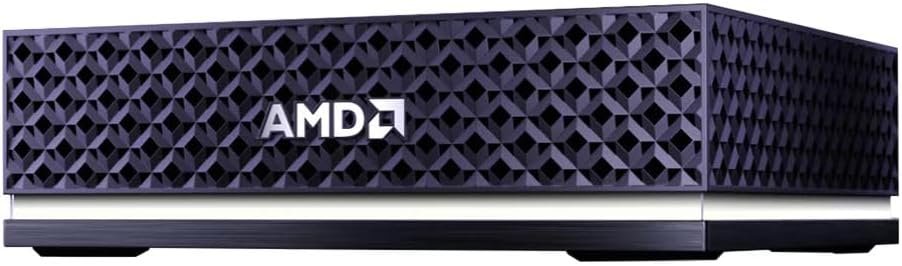

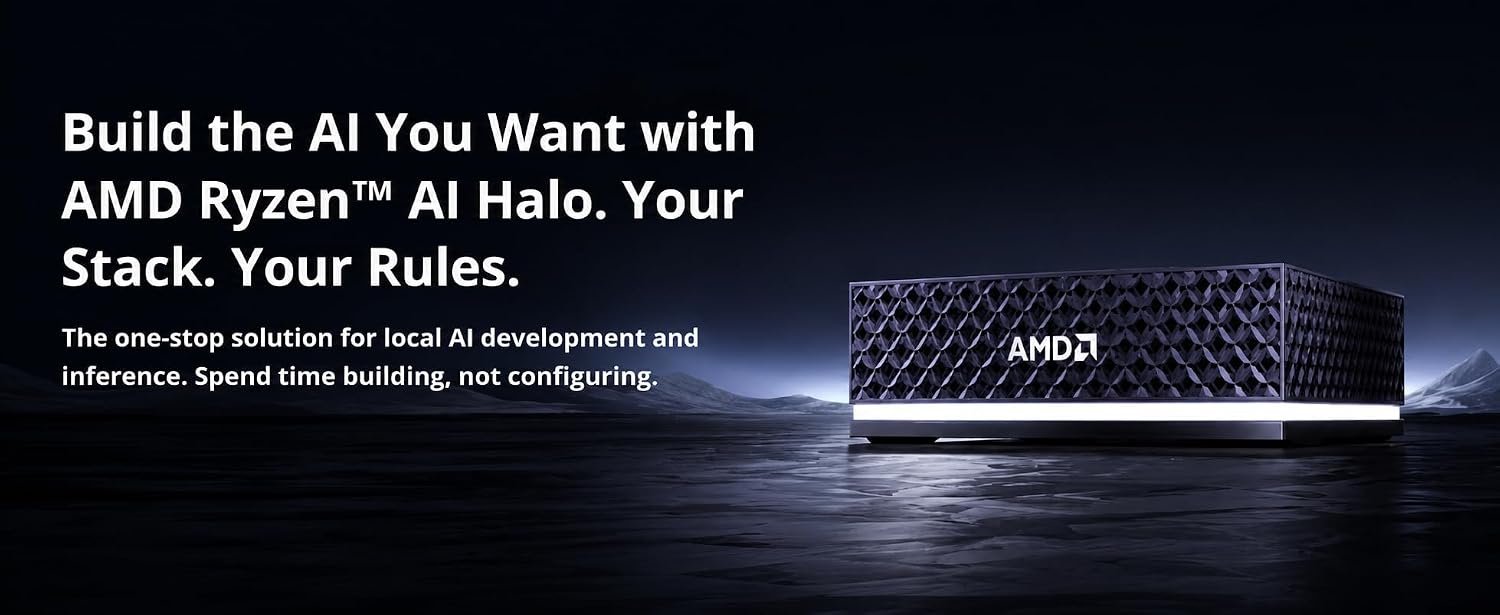
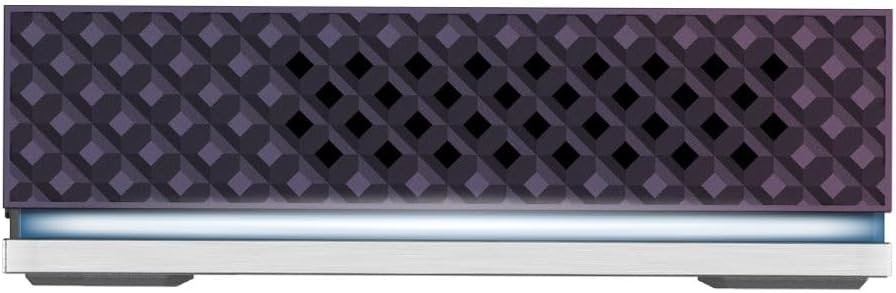





AMD Ryzen AI Halo Developer Platform (Ryzen AI Max+ 395)
Price range: $3,999.99 through $4,899.99
AMD Ryzen AI Max+ 395, 128GB LPDDR5x, 2TB NVMe SSD, Radeon 8060S — 126 TOPS AI developer platform.
The AMD Ryzen AI Halo Developer Platform is AMD’s own reference-hardware dev kit built around the flagship Ryzen AI Max+ 395 “Strix Halo” processor — designed for ML engineers and researchers who want to run local LLM inference and fine-tuning on x86 hardware with full ROCm support, rather than committing to an Arm-based platform. If your toolchain, CI pipeline, or existing model zoo assumes x86_64, this is the AMD-native alternative to the NVIDIA GB10 wave of personal AI supercomputers.
Key Features
- AMD Ryzen AI Max+ 395 Processor — 16 Zen 5 CPU cores / 32 threads at up to 5.1GHz boost (3.0GHz base), with 64MB of L3 cache, built on a 4nm process for a genuinely desktop-class x86 CPU underneath the AI hardware.
- Integrated Radeon 8060S GPU — 40 RDNA 3.5 compute units running up to 2.9GHz, giving the platform real graphics and compute-shader throughput alongside its AI-specific silicon, not just a bolt-on NPU.
- Up to 126 TOPS of Combined AI Performance — the XDNA 2 NPU alone delivers 50 TOPS; the 126 TOPS headline figure is the combined CPU + GPU + NPU platform total AMD publishes for real mixed AI workloads.
- 128GB Unified LPDDR5x-8000 Memory at 256GB/s — a single coherent memory pool shared across CPU, GPU, and NPU, with AMD’s Variable Graphics Memory letting you allocate the majority of it directly to the GPU as VRAM for large-model inference.
- 2TB NVMe SSD, Pre-Installed — ample local storage for model weights, datasets, and containers without an immediate upgrade.
- Full ROCm Support, Out of the Box — ships with AMD’s ROCm software stack pre-configured, along with AMD AI Playbooks and ready-to-run setups for tools like LM Studio, ComfyUI, and VS Code — a meaningfully more mature local-AI software story than earlier AMD hardware generations.
- 10GbE, Wi-Fi 7, and Bluetooth 5.4 — enterprise-grade wired networking alongside modern wireless, plus 3x USB-C ports (with DisplayPort Alt Mode) and HDMI 2.1b for display output.
- Compact 150 x 150 x 45.4mm Chassis — roughly 1.2kg, with a 120W TDP that keeps the whole platform desk-friendly rather than requiring workstation-tower cooling.
x86 Local AI, Backed by AMD’s Own Reference Design
The single biggest reason to choose the Ryzen AI Halo Developer Platform over an Arm-based competitor is compatibility: this is a standard x86_64 machine, which means Docker images, Python wheels, and CI pipelines built for x86 Linux or Windows just work, without the “does this package have an Arm build” question that comes with Grace-based systems. Paired with 128GB of unified memory at 256GB/s bandwidth, the platform can hold and run open-weight models in the 30B–70B parameter range locally, with AMD’s Variable Graphics Memory letting you dedicate the bulk of that pool to the GPU for inference workloads.
AMD ships this as genuine reference hardware — a custom AMD BIOS, a choice of Windows 11 Pro or a Linux configuration, and a software stack built specifically around getting local LLM workflows running fast, including AMD AI Playbooks with documented, tested setups rather than a bare OS install. That matters because ROCm’s biggest historical criticism has been setup friction — AMD has clearly targeted this specific product at closing that gap for developers evaluating the platform.
Being honest about where the ecosystem still stands: ROCm has matured substantially, but it does not yet have the breadth of pre-built container images, third-party tutorials, and community troubleshooting history that CUDA has accumulated over more than a decade. For teams already invested in CUDA-specific tooling, that’s a real migration cost worth weighing. Where this platform earns its place is for teams building on frameworks with solid ROCm support (PyTorch, llama.cpp, vLLM’s ROCm backend), who want x86 compatibility, AMD’s specific memory-bandwidth-per-dollar profile, and a genuinely well-supported local-AI reference machine rather than a repurposed gaming rig. The combined 126 TOPS figure and 256GB/s memory bandwidth make it a capable fine-tuning and inference platform for the 30B-class model range that dominates most local-development workloads today.
Specifications
- Processor: AMD Ryzen AI Max+ 395, 16 cores / 32 threads (Zen 5), 3.0GHz base / up to 5.1GHz boost, 64MB L3 cache
- Process Node: TSMC 4nm
- GPU: AMD Radeon 8060S, 40 RDNA 3.5 compute units, up to 2.9GHz
- NPU: AMD XDNA 2, up to 50 TOPS
- Combined AI Performance: Up to 126 TOPS (CPU + GPU + NPU)
- Memory: 128GB unified LPDDR5x-8000 (256-bit bus)
- Memory Bandwidth: 256GB/s
- Storage: 2TB M.2 NVMe SSD, pre-installed
- Networking: 10 Gigabit Ethernet, Wi-Fi 7, Bluetooth 5.4
- Ports: 3x USB-C (DisplayPort Alt Mode support), HDMI 2.1b
- Software: Full AMD ROCm support, AMD AI Playbooks, LM Studio / ComfyUI / VS Code preconfigured
- Operating System: Windows 11 Pro or Linux (custom AMD BIOS)
- TDP: 120W
- Dimensions: 150 x 150 x 45.4mm
- Weight: Approx. 1.2kg
- Configurations: Windows 11 Pro, Linux OS
| Configuration | Windows 11 Pro, Linux OS |
|---|
5 reviews for AMD Ryzen AI Halo Developer Platform (Ryzen AI Max+ 395)
Related products




Dell Pro Micro AI Business Mini Desktop (AMD Ryzen 5 8500GE)
Price range: $2,539.99 through $3,389.99
NVIDIA DGX Spark™ – Personal AI Desktop Supercomputer – Desktop GB10 Grace Blackwell Chip
Price range: $4,699.00 through $9,617.99

Lenovo ThinkStation PGX GB10 1T LINUX Workstation (30KL0002US)
Price range: $5,849.00 through $7,879.00


Beelink GTi15 Ultra Intel® Core™ Ultra 9 285H
Price range: $1,499.00 through $1,949.00
Paloma G. –
Doing LoRA fine-tunes on 30B-class open models in my home lab and getting solid throughput, especially once quantized to 4-bit. For the cost relative to a comparable NVIDIA unified-memory box this has been the better value for my budget.
Kwame A. –
Using this as our edge-AI dev box before deploying trained models down to smaller Ryzen-based embedded targets — having CPU, NPU and GPU sharing one memory pool makes local testing of the full pipeline far simpler than juggling separate dev machines.
Rasheed M. –
Got ROCm working with llama.cpp for 70B quantized models after setting HSA_OVERRIDE_GFX_VERSION=11.5.1 as the community forums suggested — once that’s in place it’s stable. 128GB of shared memory for the price is hard to beat if you don’t strictly need CUDA.
Elin S. –
Worth knowing going in: gfx1151 (Strix Halo) is still listed as preview support in AMD’s ROCm compatibility matrix, and a few ops fall back to CPU in practice. I actually got more consistent results switching some workloads to the Vulkan backend in llama.cpp rather than fighting ROCm. Software is clearly still catching up to the hardware, but for the price of 128GB of usable memory versus an equivalent discrete GPU setup, it’s a good trade if you’re patient.
Stefan B. –
Went in expecting closer to discrete-GPU decode speeds given the TOPS figure on the spec sheet, and reality is more modest once you hit memory-bandwidth-bound dense models — manage expectations there. Also had to update the kernel on my Linux install before ROCm would recognize the GPU properly, which wasn’t mentioned anywhere obvious. Runs well now that it’s sorted, but the out-of-box software experience needs polish.