


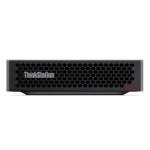



Lenovo ThinkStation PGX GB10 1T LINUX Workstation (30KL0002US)
Price range: $5,849.00 through $7,879.00
The Lenovo ThinkStation PGX is the first Lenovo workstation powered by the NVIDIA GB10 Grace Blackwell Superchip, tailored for AI development with scalable AI capabilities. 1 petaFLOP of FP4 AI performance and 128 GB of unified memory in a 1.13 litre desktop chassis — enough to prototype, fine-tune and run inference on models up to 200 billion parameters right at your desk.
The Lenovo ThinkStation PGX is Lenovo’s first workstation built around the NVIDIA GB10 Grace Blackwell Superchip — a machine designed for exactly one job: giving ML engineers, researchers and applied-AI teams data-centre-class model development power on their own desk, backed by Lenovo’s workstation-grade build quality and enterprise support. If you’ve been renting cloud GPU instances just to fine-tune or evaluate open-weight models, or fighting for time on a shared training cluster, the ThinkStation PGX collapses that entire workflow into a 1.13-litre box that sits next to your keyboard.
Key Features
- NVIDIA GB10 Grace Blackwell Superchip — a 20-core Arm CPU (10x Cortex-X925 performance cores + 10x Cortex-A725 efficiency cores) coupled to a Blackwell-architecture GPU with 5th Gen Tensor Cores and 4th Gen RT Cores over NVLink-C2C, rated for 1000 TOPS / 1 petaFLOP of FP4 AI performance with sparsity.
- 128GB Unified LPDDR5x-8533 Memory at 273GB/s — CPU and GPU share one coherent memory pool with no PCIe copy penalty, letting the PGX hold and run models up to roughly 200 billion parameters on a single unit without offloading to disk or splitting across multiple GPUs.
- Dual 200Gb/s QSFP Ports (NVIDIA ConnectX-7) — link two PGX units to scale beyond a single unit’s memory ceiling for larger model classes, using the same networking silicon NVIDIA deploys in its DGX data-centre systems.
- Self-Encrypting NVMe Storage — 1TB, 2TB, or 4TB PCIe Gen4 TLC Opal SSD options, so you can size local storage to your dataset and checkpoint volume rather than being locked into one capacity.
- NVIDIA DGX OS with Full AI Stack Pre-Installed — CUDA 13, the complete NVIDIA AI software stack, the GB10 Dashboard, and NVIDIA AI Workbench ship ready to use, running the identical container stack used across DGX systems so a workload validated here moves to a cluster or DGX Cloud unchanged.
- Enterprise-Grade Connectivity — 10 Gigabit Ethernet, Wi-Fi 7, Bluetooth 5.3, three USB4 ports carrying DisplayPort 2.1, and an HDMI 2.1a output for driving multiple high-resolution monitors alongside a training run.
- 1.13-Litre Chassis, From 1.2kg — 150 x 150 x 50.5mm, powered from a single 240W USB-C adapter — genuinely desk-sized, not a disguised tower.
- Workstation-Grade Security — self-encrypting NVMe (AES SED), TPM 2.0, UEFI Secure Boot, an NVLink-C2C hardware enclave, and NVIDIA Firmware Recovery, all the boxes an enterprise procurement checklist expects.
Built for the AI Workflow, Backed by Lenovo Support
The core value proposition of the ThinkStation PGX is architectural, not just a spec bump: unified memory. On a conventional workstation, a discrete GPU has its own VRAM pool, and any model that doesn’t fit gets offloaded to system RAM with a severe throughput penalty, or simply refuses to load. The PGX’s Grace Blackwell Superchip shares 128GB of LPDDR5x memory coherently between CPU and GPU at 273GB/s, so a 70B-parameter model in FP4/INT4 quantization — or a 30B model at higher precision with generous context length — loads and runs without the memory-juggling that plagues discrete-GPU setups. For fine-tuning workflows, quantization experiments, RAG pipeline development, and inference serving, that’s the difference between an afternoon of iteration and a memory-management project.
Because the PGX ships as a genuine ThinkStation, it comes with things a boutique dev-kit doesn’t: a 1-year limited onsite service warranty, TPM 2.0 and UEFI Secure Boot for organisations with IT compliance requirements, and packaging built from 90% recycled/FSC-certified content for teams tracking procurement sustainability metrics. For an AI studio or research group buying more than one unit, that combination of enterprise support and standardised deployment matters as much as raw compute.
It’s worth being direct about scope: this is a fine-tuning, inference, and prototyping machine, not a from-scratch foundation-model training rig. The 1 petaFLOP figure is a peak FP4-with-sparsity number — real dense-precision throughput on a given model will be lower, and pre-training multi-billion-parameter models from random initialization still belongs on a cluster. Where the PGX genuinely replaces cloud spend is the iteration-heavy work that dominates most ML engineers’ calendars: LoRA/QLoRA fine-tunes, evaluation harness runs, agentic pipeline prototyping, and computer-vision or multimodal model development, run entirely on hardware your organisation owns and controls — a meaningful advantage for teams handling data that can’t leave the premises.
Running NVIDIA DGX OS (an Ubuntu Linux Pro-based distribution) means the software experience is the one NVIDIA itself maintains and ships to enterprise DGX customers, not a community-patched ARM port — which meaningfully de-risks the “will my framework even work on Arm” question that comes with any Grace-based system. Choose your storage configuration — 1TB, 2TB, or 4TB — based on how many model checkpoints, quantized variants, and datasets you expect to keep local at once.
Specifications
- Part Number (MTM): 30KL0002US
- Model: ThinkStation PGX GB10 1T LINUX
- Superchip: NVIDIA GB10 Grace Blackwell Superchip
- CPU: NVIDIA Grace 20-core Arm CPU (10x Cortex-X925 + 10x Cortex-A725)
- GPU: NVIDIA Blackwell architecture GPU with CUDA Cores, 5th Gen Tensor Cores, 4th Gen RT Cores
- AI Performance: 1000 TOPS / 1 petaFLOP (FP4, with sparsity)
- Memory: 128GB LPDDR5x-8533MT/s unified system memory, 273GB/s bandwidth
- Storage: 1TB / 2TB / 4TB SSD M.2 2242 PCIe Gen4 TLC Opal (self-encrypting)
- Operating System: NVIDIA DGX OS (Ubuntu Linux Pro base)
- Pre-installed Software: NVIDIA AI Software Stack, CUDA 13, GB10 Dashboard, NVIDIA AI Workbench
- Max Model Size: Up to 200B parameters (single unit)
- Rear I/O: 1x USB-C power in (PD 3.1); 3x USB-C USB4 (20Gb/s) with DisplayPort 2.1; 1x HDMI 2.1a with multichannel audio; 1x RJ-45 10GbE; 2x QSFP (NVIDIA ConnectX-7, 200Gb/s)
- Wireless: Wi-Fi 7 (802.11be) + Bluetooth 5.3 LE
- Power Supply: 240W USB-C power adapter
- Form Factor: Small form factor desktop, 1.13 litre, 150 x 150 x 50.5mm
- Weight: From 1.2kg
- Security: Self-encrypting NVMe (AES SED), TPM 2.0, NVLink-C2C enclave, NVIDIA Firmware Recovery, AMI setup password, UEFI Secure Boot
- Warranty: 1-year limited onsite service
- Sustainability: Packaging with 90% recycled and/or FSC-certified content; RoHS compliant
| Weight | 2.65 lbs |
|---|---|
| Dimensions | 5.91 × 5.91 × 1.99 in |
| Storage | 1TB SSD, 2TB SSD, 4TB SSD |
5 reviews for Lenovo ThinkStation PGX GB10 1T LINUX Workstation (30KL0002US)
Related products


ASUS Ascent GX10 AI Supercomputer (NVIDIA GB10 Superchip)
Price range: $5,899.00 through $7,899.00

HP Z2 Mini G1a Workstation (AMD Ryzen AI MAX PRO)
Price range: $3,523.99 through $4,406.83



Beelink GTi14 Ultra AI PC Intel® Core™ UItra 9 185H (OpenClaw Pre-Installed)
Price range: $1,099.00 through $1,399.00

Pre-installed OpenClaw SSD Upgrade Kit
Price range: $189.00 through $529.00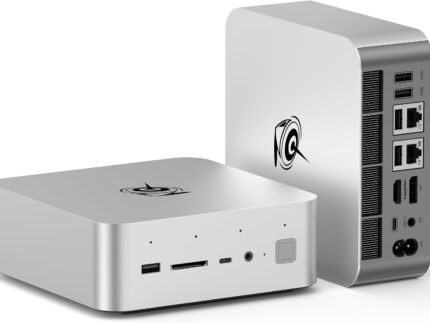

Kenji O. –
The single 240W USB-C power brick is such an underrated feature — I travel between our office and a client site monthly and being able to just grab one cable instead of a full workstation PSU has been genuinely convenient. 1.13 litre chassis, barely bigger than a paperback, and it handles our inference demos without breaking a sweat.
Diego R. –
Small AI consultancy here — we bought two of these specifically for the fine-tune-locally-then-deploy-to-DGX-Cloud workflow, and the fact that Lenovo backs it with proper enterprise warranty and asset management tools made it an easy sell internally versus building a rig ourselves. Procurement was painless too.
Zainab Y. –
Solid machine overall. Had one firmware update needed in the first month to fix an intermittent WiFi 7 drop, which Lenovo support walked me through quickly, but it shouldn’t have shipped that way on hardware at this price. Once patched, completely stable running multi-day fine-tuning jobs.
Ravi S. –
Our research lab needed something we could put on a shared bench without an IT ticket every time it needed servicing, and the Lenovo ThinkStation build quality shows here — TPM 2.0, Secure Boot, self-encrypting NVMe all standard, which our compliance team appreciated. Performance-wise it’s the same GB10 Grace Blackwell platform as the reference DGX Spark, so expect the same unified-memory behavior: great for fitting 70-200B models, bandwidth-bound on decode for dense architectures.
Chloe B. –
NVIDIA AI Workbench being pre-installed alongside the usual CUDA stack was a nice touch — made handing this off to a less Linux-comfortable teammate much easier. Same caveat as every GB10 box: don’t expect discrete-GPU decode speeds on large dense models, this is a unified-memory-bandwidth-limited machine. Still the best local option we’ve tried for fine-tuning without cloud costs.